
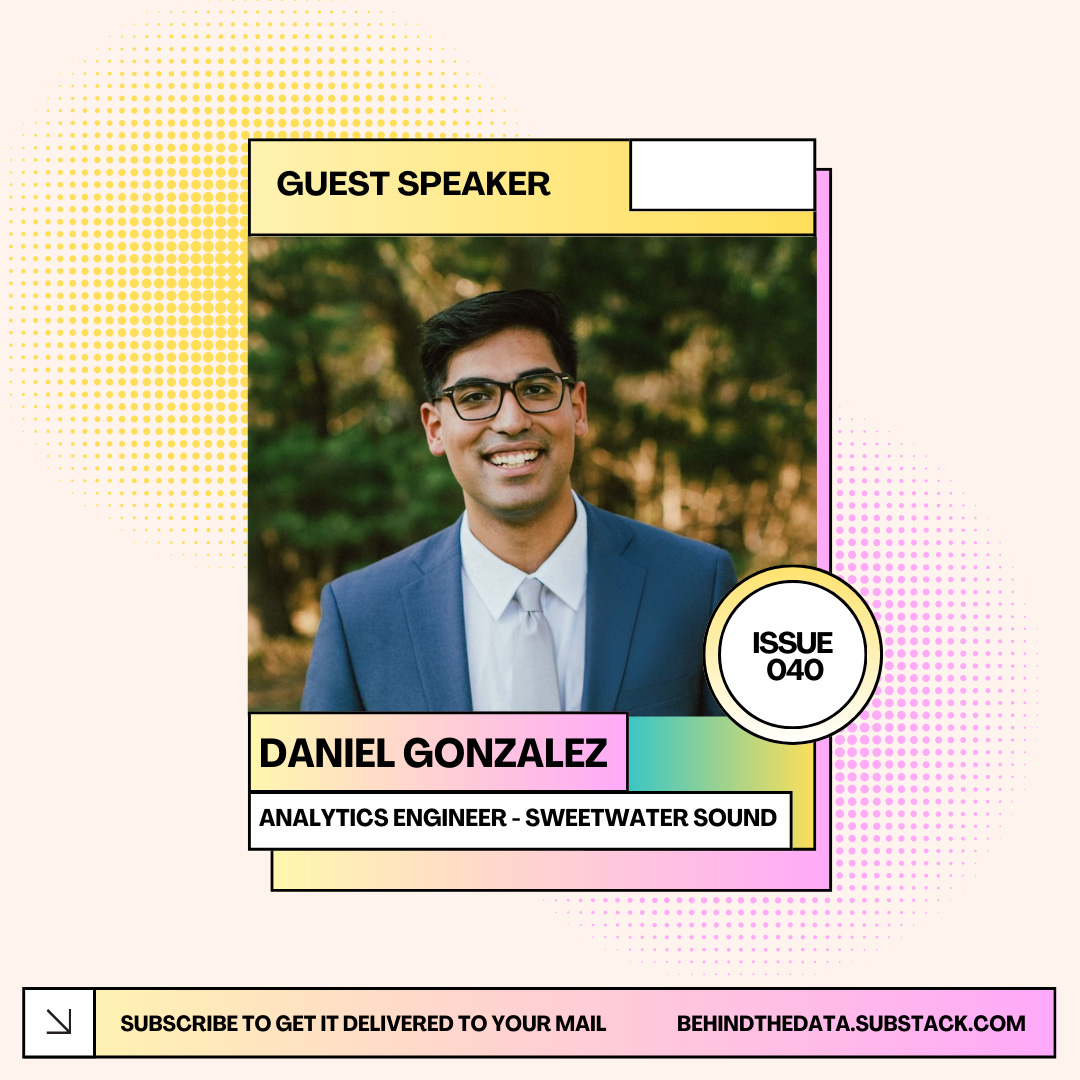
Issue 040 — Meet Daniel Gonzalez
What I enjoy most about data & analytics is that it naturally blends technology and business processes. One metric our team closely monitors is the cost of queries in our data warehouse.


Some people discover data through code. Others discover it through curiosity.
For Daniel Gonzalez, the path into data was shaped by two things: communication and curiosity.
From public speaking in high school to working through financial datasets in Excel, Daniel realized something powerful: asking the right questions and clearly communicating the answers can change decisions, outcomes, and even lives.
Now an Analytics Engineer at Sweetwater Sound, Daniel sits at the intersection of business and technology, modeling data in ways that empower teams to make better decisions. In this conversation, he shares lessons on delivering value quickly, modeling data intentionally, communicating with nuance, and building trust across departments.
🎙 Behind the Data Podcast is now live on Spotify.
We’re gradually bringing selected conversations to audio.
You can explore the available episodes on here
Key Takeaways
Communication is the real differentiator
Data professionals must translate between business and technology. Timing, clarity, and empathy matter just as much as technical skill.Model with intention
Thinking in facts and dimensions and designing with the end goal in mind creates scalable, self-service systems.Speed beats perfection
A minimum viable product keeps the business engaged and builds momentum.Impact > Flashy tools
It’s not about AI buzzwords or the newest stack. It’s about helping leaders make better decisions.Measure what matters, even internally
Tracking query costs sparks smarter conversations about efficiency and value.
What are some key skills that are often overlooked in your field of data?
Communication, communication, communication.
As data professionals, we sit right at the intersection of business and technology. We have to speak two languages and translate between them clearly. Having good timing and well-delivered messaging can completely change how stakeholders receive your work.
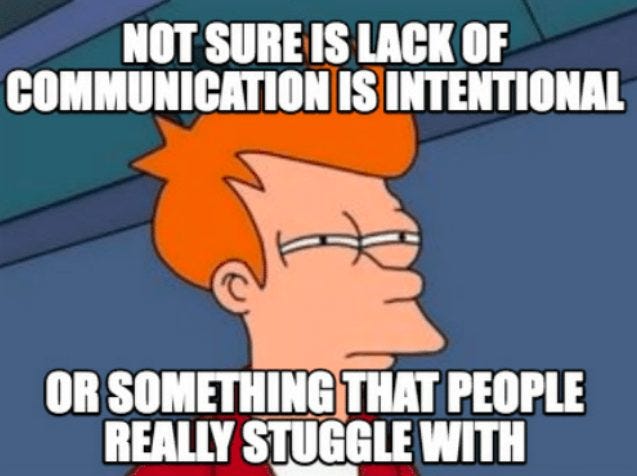
In IT, it’s easy to frame things in binary terms, i.e., this is correct or this is incorrect. But other departments often operate in nuance. Stepping into their perspective and understanding how they think is incredibly helpful when trying to deliver something meaningful.
Can you reflect on a setback in your data career and what you learned from it?
In my first role, I was part of a very small data team that was a newer initiative within the company. We faced big challenges trying to define our place and prove where we could make the most impact. The process took longer than expected, and leadership struggled to clearly see the value we were bringing.
That experience shaped me in two major ways.
First, I learned the importance of delivering quickly. Not perfectly but quickly. A minimum viable product keeps the business engaged and creates momentum for something truly impactful.
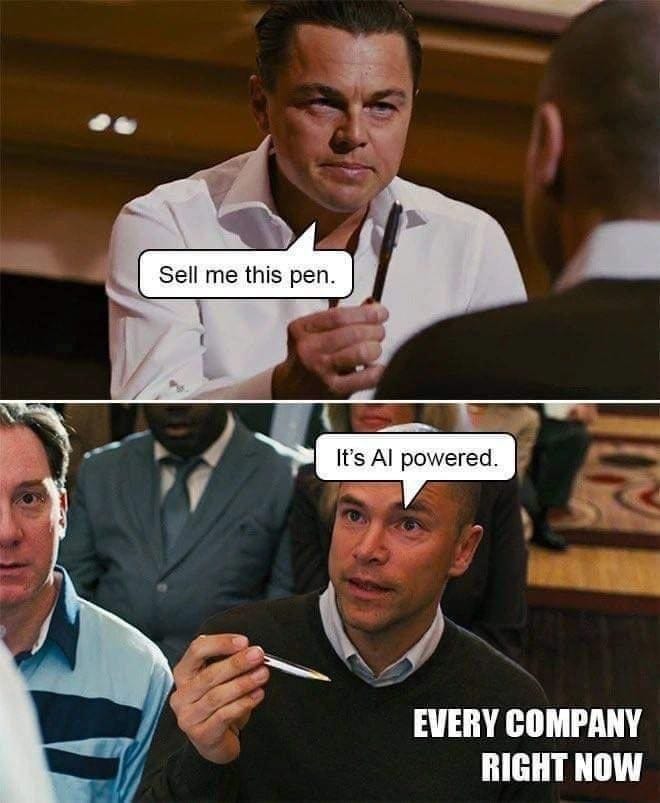
Second, when evaluating future opportunities, I realized I needed to work in environments that genuinely see and invest in data. It’s not about flashy tools or AI buzzwords. It’s about tangible impact that helps leaders make better decisions and makes workflows more efficient.
What inspired you to pursue a career in data, and how has your motivation evolved over time?
It has really been the culmination of several interests coming together.
In high school, I developed a deep passion for public speaking. I loved the research process, building an outline, and delivering a message in a way that truly resonated. Later, working at a church helped me refine that skill, learning how to communicate effectively across different ages, cultures, and backgrounds.
I’ve also long been interested in finance and economics. My first exposure to data analysis came when I was working with a financial dataset in Excel. I started asking simple questions and realized I could answer them with just a few functions. Those insights helped me make financial decisions that significantly impacted my personal life.
Bringing together effective communication and relentless curiosity, Data & Analytics felt like a natural fit. My goal is to understand processes deeply enough to help others answer meaningful questions that improve lives or help teams achieve greater goals.
Can you share a pivotal moment in your career that significantly shaped your approach to data?
Early in my first data role, I had the privilege of working alongside incredibly talented professionals. One foundational concept they instilled in me was Kimball data modeling.
Since then, whenever I approach a new project, I instinctively think in terms of facts and dimensions. Once data is structured that way, it becomes significantly easier to use in BI tools like Looker or Tableau. If a stakeholder needs a new event tracked, it can be added to a fact table. If they need an attribute, it belongs in a dimension table.
Over time, I’ve evolved toward modeling data with the end goal of surfacing “One Big Table” to enhance self-service capabilities. While slightly different from classic Kimball, the mindset remains the same: structure data intentionally so it empowers the business.
How do you balance the technical aspects of your role with the need for creative problem-solving?
What I enjoy most about data & analytics is that it naturally blends technology and business processes.
Some decisions are straightforward. Others are ambiguous, requiring creativity to choose the best approach.
Two recurring examples where creativity shows up:
1. Data Modeling
Is this a simple star schema?
Should I implement Type 2 slowly changing dimensions?
How granular should this data be?
Can I pre-aggregate to reduce query costs?
2. Metric Definitions
Sometimes the “perfect” metric isn’t feasible with the available data. In those cases, I collaborate with stakeholders to redefine the metric or adjust it slightly so it remains meaningful and actionable.
The creativity comes from navigating ambiguity while staying grounded in sound technical principles.
How do you foster a culture of data-driven decision-making within your team or organization?
One metric our team closely monitors is the cost of queries in our data warehouse.

That single metric sparks incredibly productive conversations:
Can we optimize this model?
Is this dashboard worth the cost?
What is the minimum feature set needed to make this report valuable?
Tracking query costs forces us to think intentionally, not just about building dashboards, but about building efficient and meaningful ones. It shapes both our modeling decisions and our stakeholder conversations.
Can you discuss a project where data insights led to unexpected outcomes or revelations?
As an analytics engineer, I often sit between business stakeholders and technical teams generating the data.
Unexpected insights frequently surface not just from dashboards but also from discovering better ways to capture or retrieve data within a process. Sometimes we identify gaps in tracking that, once addressed, unlock entirely new insights.
Those moments are exciting as they reveal potential for growth. But they can also be frustrating when implementing the change requires significant time and coordination.
Still, those discoveries are often the turning points that push the organization forward.
🎙 Behind the Data Podcast is now live on Spotify.
We’re gradually bringing selected conversations to audio.
You can explore the available episodes on here
What role does mentorship play in your career, and how have mentors influenced your journey?
Mentorship has been enormous in my growth.
In my first role, my manager and the consultants we worked with served as mentors. They were experienced and gifted teachers, and they helped me build a strong foundation that still supports me today.
At my current company, there’s a structured mentorship program that pairs employees with someone in IT for a few months. That experience has allowed me to keep developing while working on real-world projects. It’s been invaluable.
What resources (books, courses, tools) do you recommend for people to level up their skills?
Fundamentals of Data Engineering by Joe Reis: A well-rounded perspective on ingestion, storage, modeling, and analytics.
Google Data & Analytics Professional Certificate: Excellent for beginners building foundational skills.
Analytics Engineering Fellowship (Behind The Data Academy): A practical, real-world program where you learn to build clean, reliable data models and work on real business cases using modern analytics tools.
If not data, what else and why?
I think I would be an airline pilot.

I’ve loved planes since I was a kid. Even now, when I’m at the airport, I probably still look like that same little kid watching planes land and take off.
What do you love outside of data?
I love being outdoors, hiking, biking, and anything that gets me away from a computer.
I also love traveling. Experiencing different cultures, trying new foods, and seeing new places always refreshes and excites me.
🎙 Behind the Data Podcast is now live on Spotify.
We’re gradually bringing selected conversations to audio.
You can explore the available episodes on here
👋 Wrapping Up
Daniel’s journey is a reminder that analytics is not purely technical, it’s deeply human.
It requires curiosity to ask better questions.
It requires structure to model data well.
And it requires communication to ensure insights actually land.
Behind every dashboard is a decision.
Behind every model is a process.
And behind every meaningful data career is someone committed to impact over noise.
If his journey inspires you, connect with Daniel on LinkedIn to follow his work and insights in the data space.
Loved this story? Please share it with someone curious about data or subscribe to discover more behind-the-scenes journeys of professionals turning data into impact.
Best,
Ayoade Adegbite
Founder, Behind the Data